
Guide to door measurements
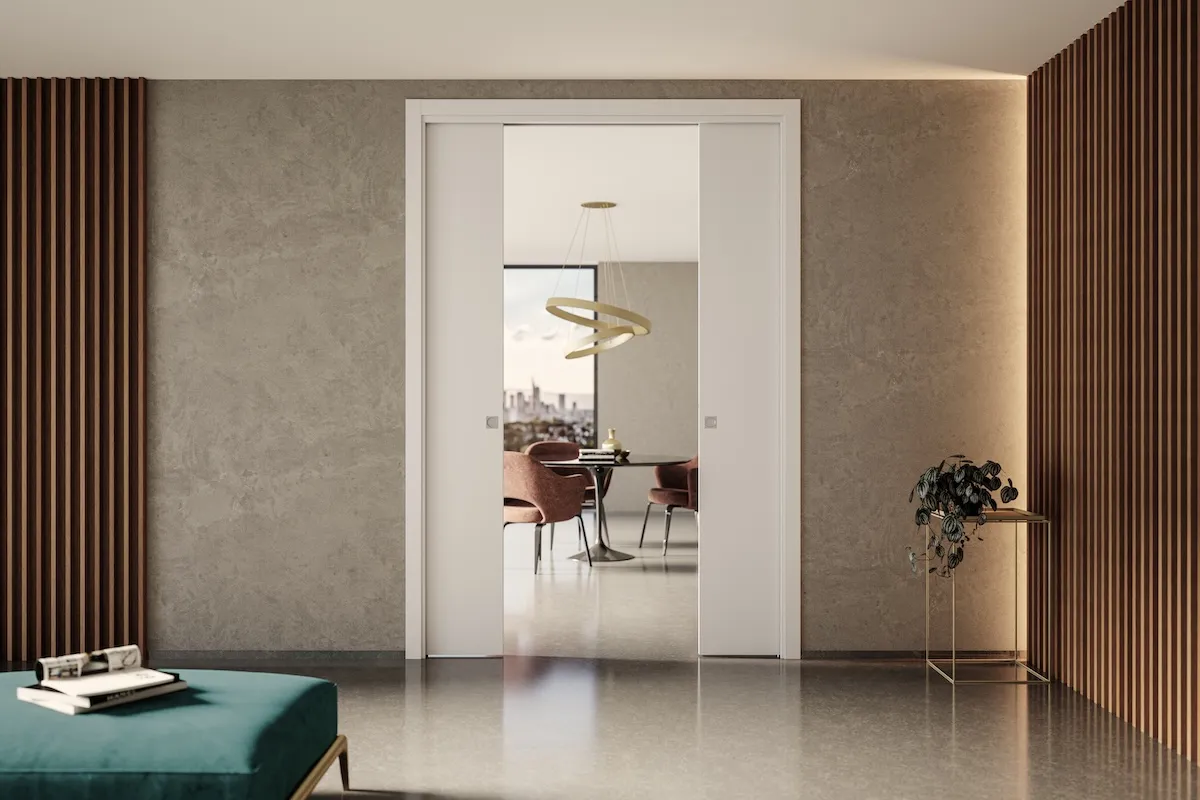
When renovating a space or designing a home, the choice of interior doors impacts both the aesthetic and functionality of the spaces. To avoid construction errors and installation issues, it is essential to know the available dimensions (clear opening) and the space requirements of various systems (swing, sliding, telescopic). This guide helps you understand the standard dimensions offered by Ermetika, how to correctly measure, and what considerations to take into account based on the type of opening.
Standard Dimensions of Interior Doors
Interior doors have standardized dimensions to facilitate production and installation. The most common sizes are:
Width (clear opening): 60, 70, 80, 90, and 100 cm.
Height (clear opening): 200, 210, and 240 cm.
These dimensions refer to the clear opening (W × H), i.e., the net opening of the wall before installing the frame or subframe. In Ermetika's technical sheets, for each clear opening, the door size (slightly smaller) and the total space requirement (W × HT) including frame, subframe, and profiles are also indicated. For example:
A flush hinged door Absolute Swing can have a clear opening width from 600 to 1000 mm and a height from 1500 to 2700 mm. The total space requirement is calculated as W + 120 mm in width and H + 60 mm in height.
The flush sliding door Absolute Evo (single panel) provides widths from 600 to 1000 mm for walls of 107 mm and from 600 to 1200 mm for walls of 125/150 mm, with heights from 1000 to 2700 mm. The space requirement is calculated as 2W + 110 mm in width and H + 90 mm in height for 107/125 plaster walls.
Sliding doors with jambs Evolution (single panel) start from standard widths 600–1000 mm (90 mm wall) and go up to 1200 mm or 1500 mm for thicker walls; the height varies from 1000 to 2700 mm. The total space requirement is 2W + 120 mm in width and H + 90 mm in height.
These values can be extended with custom sizes: some lines offer heights up to 2700 mm and greater widths for accessibility needs or scenic effects.
When is a Custom Door Needed?
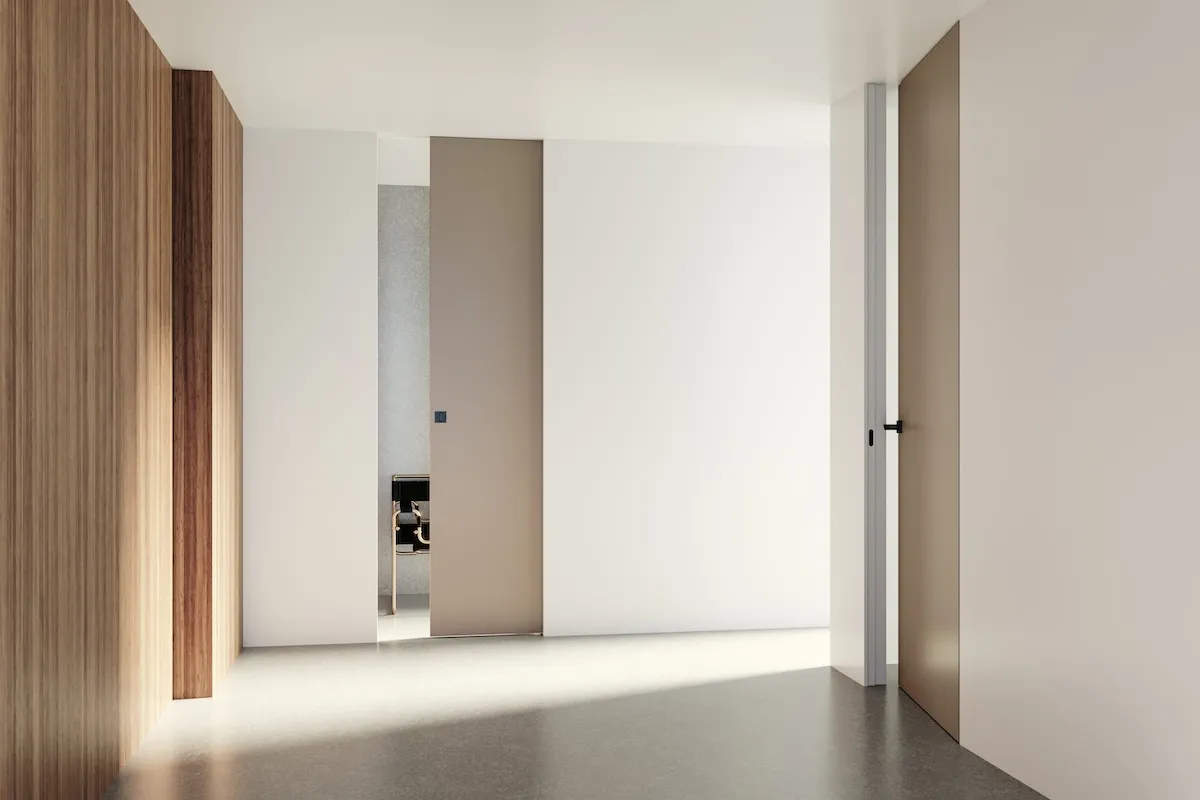
Custom doors are useful in various contexts:
In the presence of very high ceilings or lowered ceilings.
When a scenic or minimalist effect is desired (e.g., full-height doors).
In historic homes, where wall openings do not meet modern standards.
For accessibility needs (e.g., wider passages for people with reduced mobility).
In these cases, it is essential to rely on manufacturers capable of customizing every component, maintaining the correct technical proportions.
How Much Space is Needed to Install a Door?
In addition to the clear opening, the space requirement must be considered. The space requirement is the actual space that the door and frame occupy in the wall. To avoid mistakes:
Measure the height of the wall opening from the finished floor to the crossbar (head) of the subframe.
Measure the width of the wall opening (distance between the subframe uprights) in three points: at the base, in the center, and at the top.
Check the horizontal alignment of the crossbar and floor: any slopes can reduce the clear opening.
Measure the wall thickness and the thickness of the subframe or crossbar; measure the thickness of the hinge side and the strike side.
Check for the presence of coverings or tiles: indicate the height of the covering and, if the covering is not yet installed, add its thickness to the wall measurement.
In the Ermetika configurator, enter the width (W) and height (H) measured in millimeters. The system will calculate the ideal space requirement for the chosen subframe or frame.
Sliding Doors and Swing Doors: Differences in Measurement and Space Requirement
HINGED Doors
Hinged doors are traditional and require space for the panel to rotate. The clear opening is smaller than the wall opening because the frame takes up space. For example, for the Absolute Swing line, the frame adds 120 mm in width and 60 mm in height.
Advantages: simple construction, low cost.
Disadvantages: require space for opening; the net clear opening is reduced.
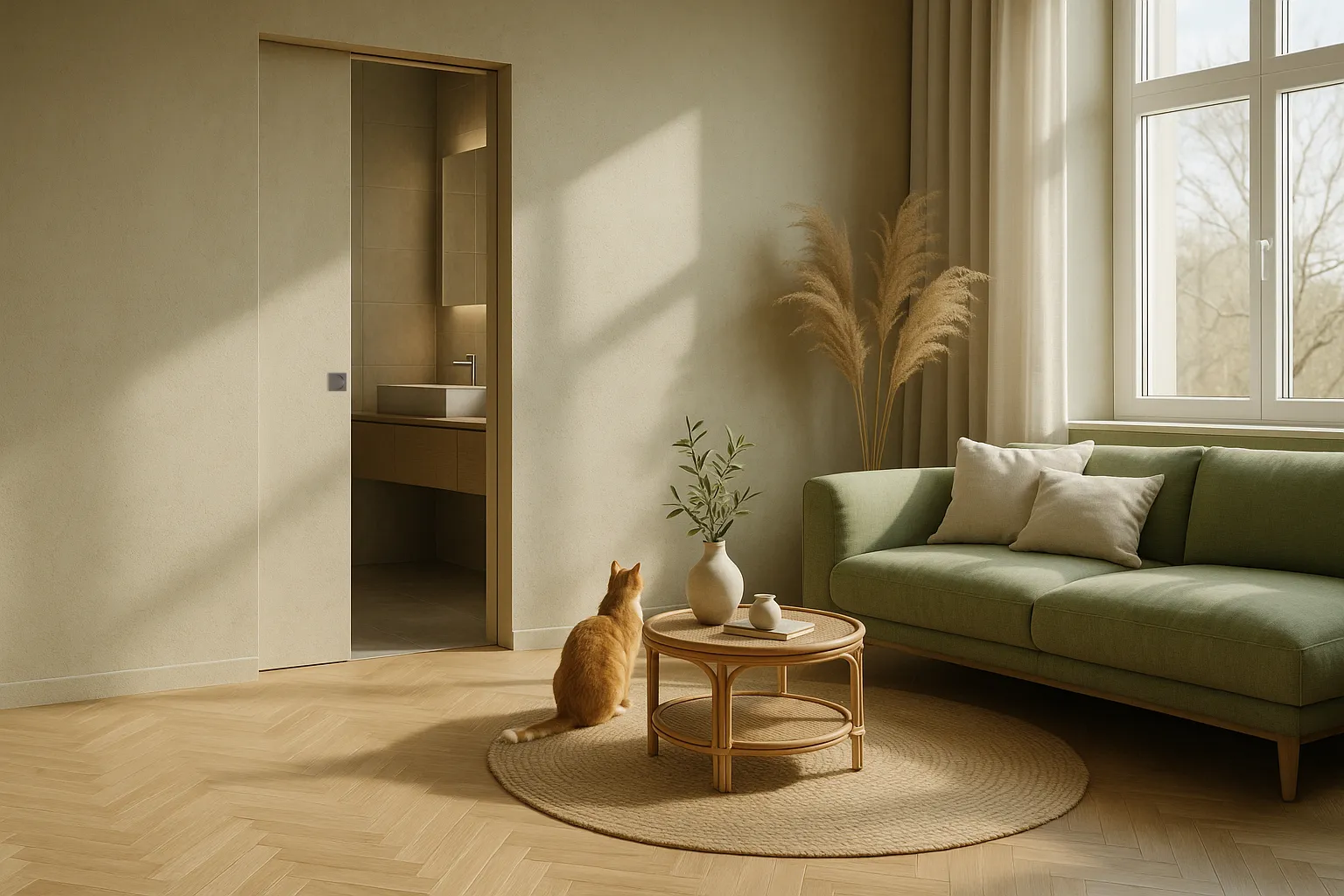
Sliding Pocket Doors
Sliding pocket doors eliminate the panel's space requirement and slide inside a subframe. However, they require sufficient wall thickness (from 90 to 150 mm depending on the model) and a cavity free of installations. The typical dimensions of flush sliding doors Absolute Evo range from 600 to 1200 mm in width for a single panel, with heights up to 2700 mm. The total space requirement is 2W + 110/120 mm and H + 90 mm.
Advantages: maximize space, allowing furniture to be placed near the opening. The effective clear opening is often larger than a swing door of the same size.
Disadvantages: require masonry work and an adequate subframe; not suitable for load-bearing walls or walls with installations.
External Sliding and Telescopic Doors
External sliding doors slide along the wall; they do not require a subframe but leave the panel visible. This system allows installation even after the walls are built, offering the possibility of creating an opening without invasive structural work. However, it is important to consider that the panel moves externally to the wall rather than within its thickness. Telescopic doors (Staffetta) are systems with overlapping panels that double the width of the opening: the single model ranges from 1150 to 2350 mm in width, while the double version reaches 4700 mm. For these, the space requirement is calculated as 1.5W + 150/190 mm and H + 80/90 mm. The net clear opening is reduced by 100–200 mm when the doors are closed due to the overlapping panels.
Discover the technical sheet of the telescopic door Staffetta
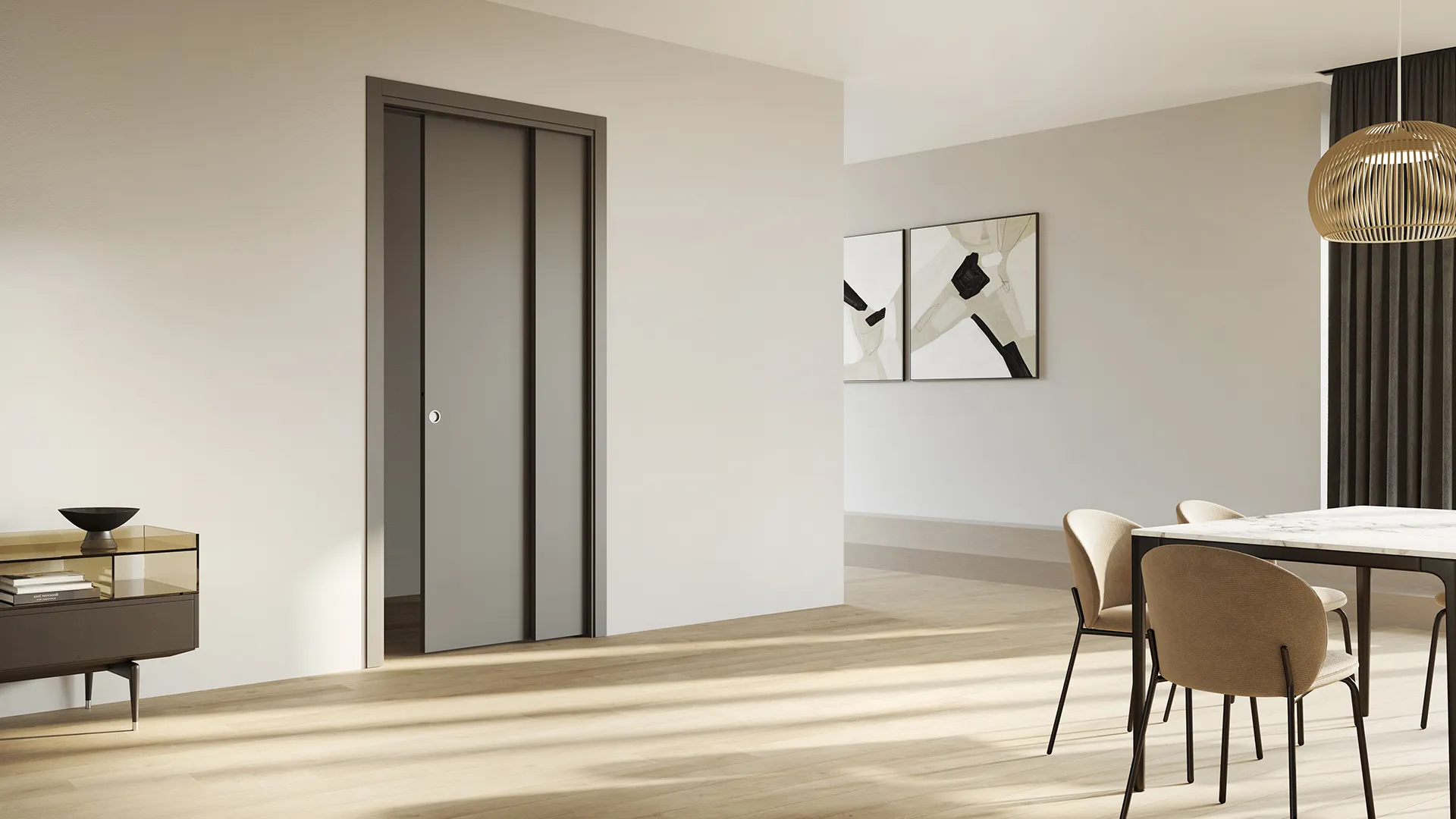
Practical Tables: Examples of Measurements and Clear Openings

To choose the right interior door, it is essential to know the measurements and characteristics of your space. Knowing the clear opening, calculating the total space requirement, and evaluating the differences between swing and sliding doors allows you to optimize space, improve accessibility, and enhance every room.
Discover the Range of Ermetika Doors
Visit our product categories or request personalized support to find the perfect solution for your spaces.
Further Reading: