
Product focus 05/19/2026
Difference between external sliding doors and pocket sliding doors
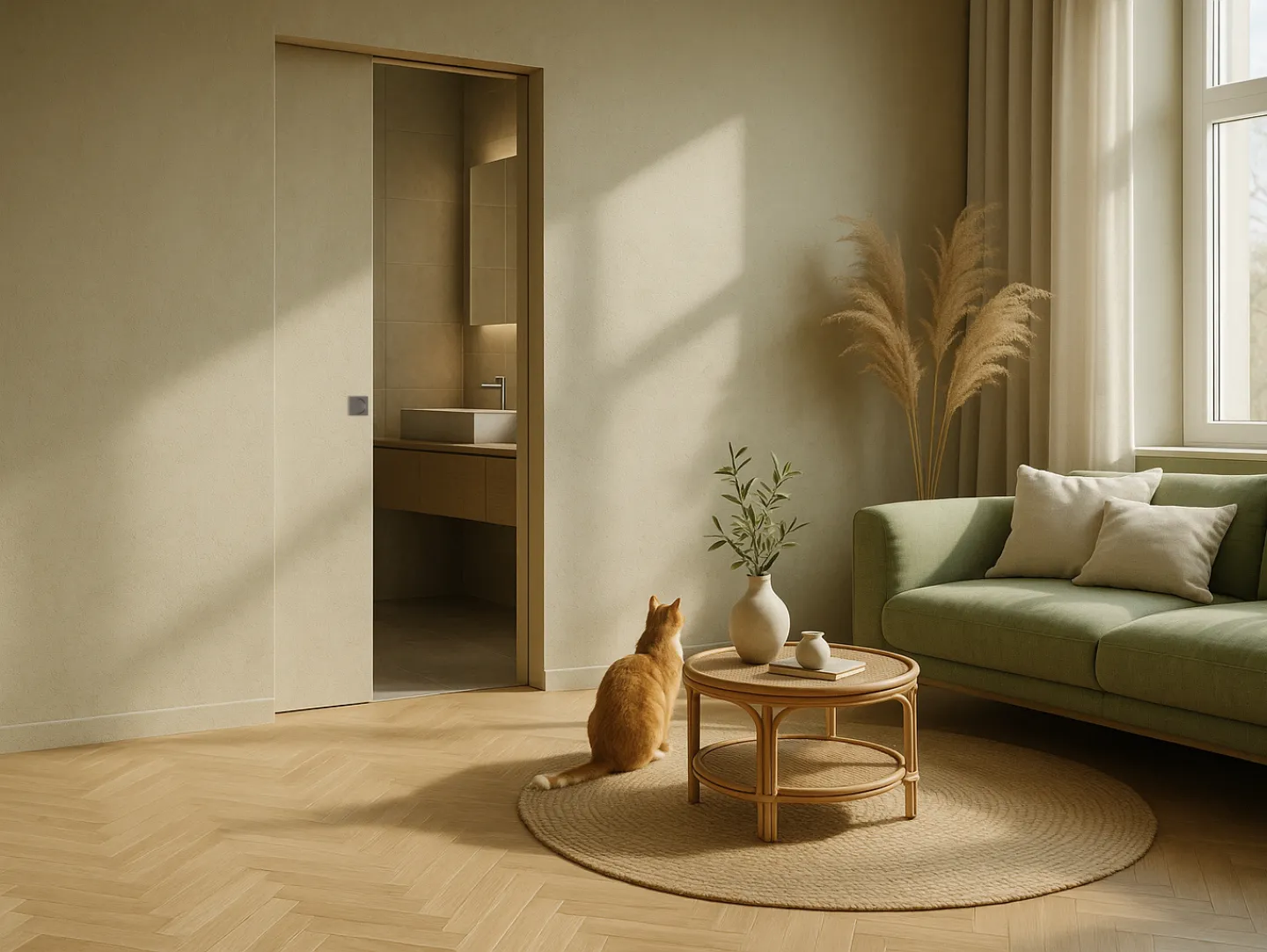
Choosing the right door means giving character to a space while making the most of every centimeter. When it comes to sliding doors, two solutions take center stage: the external sliding door and the pocket sliding door. They may seem similar, but they tell profoundly different design stories.
In this article, you’ll discover the features of each solution, their advantages and disadvantages, and the criteria for understanding which one best suits your spaces. Understanding the difference between an external sliding door and a pocket sliding door will allow you to make an informed decision that combines aesthetics and functionality.
With over 30 years of experience in the production of sliding and flush doors, Ermetika guides designers, architects, and private customers toward the most refined choice for every project.
External sliding door: features and advantages
The external sliding door is a solution in which the door panel slides along the outside of the wall, guided by visible tracks. The mechanism is not concealed; on the contrary, it becomes a decorative element that enhances the space.
This type is perfectly suited to modern spaces, lofts, and interiors with an industrial feel. The metal track, often made of steel or aluminum, adds a distinctive architectural touch and highlights textured surfaces such as concrete, exposed brick, or natural wood.
Imagine a wooden door panel gliding elegantly along an exposed track, creating a play of lines and volumes that gives character to the wall. It is a bold design choice, ideal for those who like to showcase the technical component as an integral part of the décor.
Installing an external sliding door: simple and without masonry work
Since the system remains outside the wall, it does not require complex masonry work. The track is fixed above the doorway and the door panel slides sideways, leaving the wall intact. This makes installation quicker, especially in renovations where there is no desire to open up the wall.
Read also: External wall-mounted sliding door with visible track: aesthetic advantages
Installing an external sliding door: simple and without masonry work
Since the system remains outside the wall, it does not require complex masonry work. The track is fixed above the doorway and the door panel slides sideways, leaving the wall intact. This makes installation quicker, especially in renovations where there is no desire to open up the wall.
Read also: External wall-mounted sliding door with visible track: aesthetic advantages
In practical terms: if you are looking for a striking visual effect with a less invasive installation, the external sliding door is an immediate and impactful solution.
Pocket sliding door: features, advantages, and minimalist design
The pocket sliding door represents the opposite design philosophy: the door panel disappears completely inside the wall thanks to an integrated pocket frame. When the door is open, the surface remains free and clean, as if the door did not exist at all.
Its greatest strength is the effect of continuity. No visible track, no bulk—just harmonious, uninterrupted walls. It is the perfect choice for those who love minimalism and want understated, elegant interiors free from visual interruptions.
Ermetika offers several solutions designed for this purpose, such as the Evolution pocket frame for sliding doors with architraves, or the iconic flush-to-wall Absolute Evo line, which integrates the door into the wall with a result of rare refinement.
Pocket sliding door: the ideal solution for optimizing small spaces
By concealing the door panel inside the wall, the pocket sliding door frees up valuable space. It is the perfect answer for compact bathrooms, storage rooms, narrow hallways, or small apartments, where every centimeter matters.
In practical terms: if your goal is to optimize space and achieve a discreet, sophisticated design, the pocket sliding door is the way to go.
External sliding door vs pocket sliding door: advantages and disadvantages compared
To help you choose, here is a clear comparison between the two solutions.
External sliding door: pros and cons
Advantages:
- Visible system that adds character and industrial style
- Easier installation, with no masonry work required
- Easy access to the mechanism for maintenance and adjustments
- Ideal for quick renovations
Disadvantages:
- The track and door panel remain visible even when the door is open
- It occupies a portion of the wall adjacent to the doorway
- Less suitable for interiors with a minimal, continuous design
Pocket sliding door: pros and cons
Advantages:
- Clean visual continuity and minimalist aesthetics
- Maximum space saving: the door panel disappears into the wall
- Elegant and discreet solution, perfect for any environment
- Wide range of customization options for finishes
Disadvantages:
- Requires more work during installation, as the pocket frame must be integrated into the wall
- Maintenance of the internal mechanism is less immediate
- Best planned during the construction or renovation stage
External sliding door or pocket sliding door: which should you choose?
Ultimately, the difference between an external sliding door and a pocket sliding door comes down to a choice of style and functionality. Here are a few criteria to help you decide.
When to choose an external sliding door: ideal use cases
- You love a visible design feature and an industrial or contemporary touch
- You want easy access to the sliding mechanism
- You prefer a quicker installation, without opening the wall
- You want to highlight the door panel as a true furnishing element
When to choose a pocket sliding door: ideal use cases
- You are looking for a clean, minimal environment without visual interruptions
- You have limited space to optimize as much as possible
- You are designing or renovating and can integrate the pocket frame
- You want an elegant, timeless result, like Ermetika’s solutions
In practical terms: consider the style of the space, the time available, and your space requirements. From there, the choice that best suits you will become clear.
Explore Ermetika’s collections of sliding and flush doors, or try the online configurator to find the ideal pocket frame. Your space deserves an elegant, functional, and tailor-made solution.
Find out more:
Wood-effect laminate sliding doors: echo doors
When to choose an external wall-mounted sliding door?
External wall-mounted sliding doors: aesthetics and functionality
Find out more:
Wood-effect laminate sliding doors: echo doors
When to choose an external wall-mounted sliding door?
External wall-mounted sliding doors: aesthetics and functionality