
Technical insights 10/08/2026
Flush or traditional doors: differences and advantages
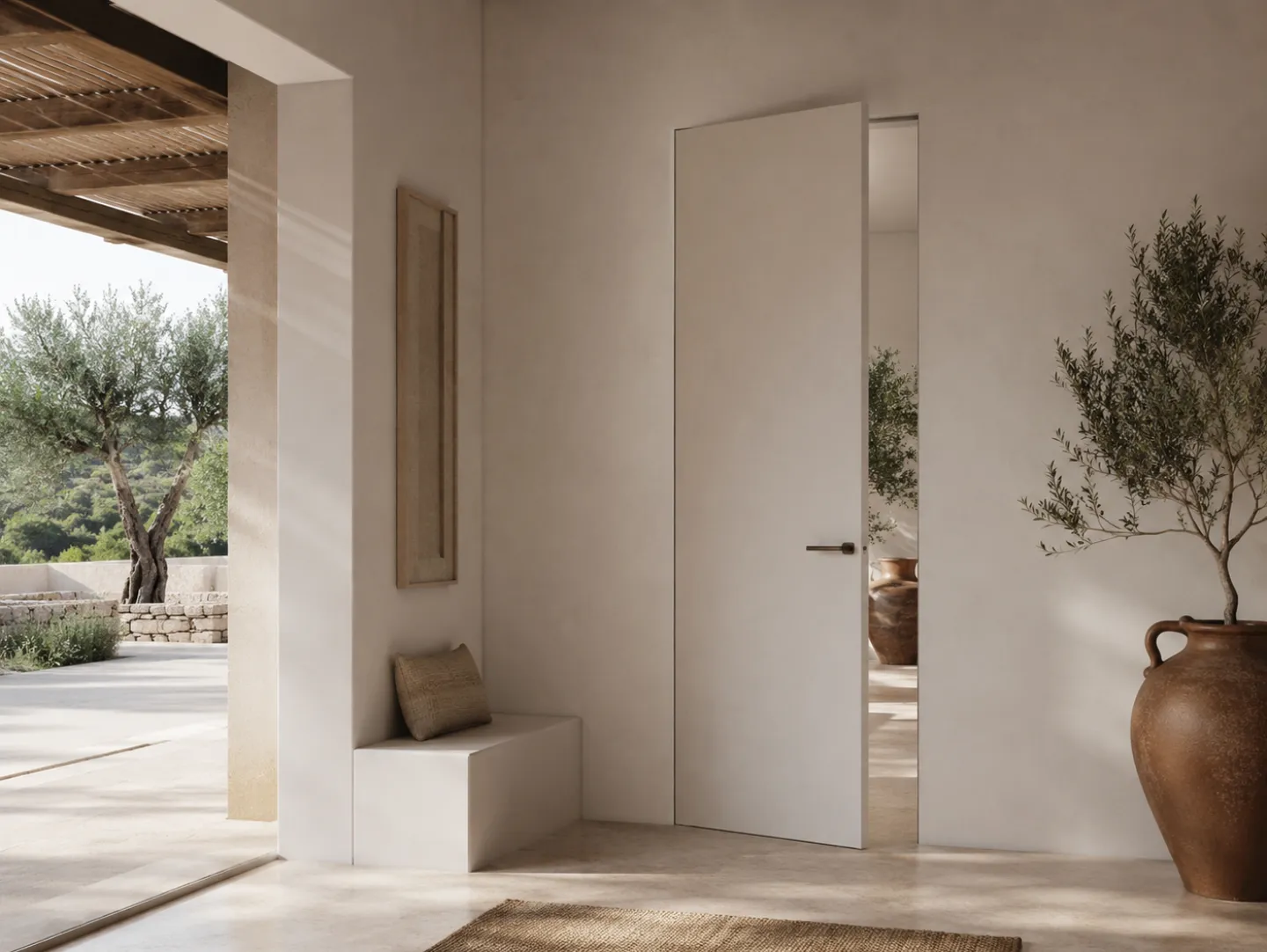
Choosing a door means defining how we establish the boundaries between one room and another. These are two different approaches to interior design, based on the choice between a traditional, classic and ornate door, or a flush door, which is elegant and discreet.
This article explores in detail the differences between flush doors and traditional hinged doors, offering a complete guide to identifying the model that best suits your interior design project.
This article explores in detail the differences between flush doors and traditional hinged doors, offering a complete guide to identifying the model that best suits your interior design project.
The main differences
In the context of interior design, the traditional hinged door reflects a choice inspired by ‘classic’ style. Its role is to visually mark the division between rooms, through a design characterised by carved panels, mouldings and details that often require ample clear space within the door’s swing radius, which must be carefully calculated when arranging the furniture. The flush door is the emblem of modern minimalism. By eliminating any protruding elements, it sits flush with the wall, creating a surface free from visual interruptions. More than just a means of closing off a space, the flush door becomes a genuine architectural feature.
The advantages of the flush system
A flush door offers architects and interior designers the utmost creative freedom. The absence of door frames and architraves allows for a high degree of aesthetic customisation. It can be painted the same colour as the wall or covered with wallpaper, thereby creating a “disappearing” effect that gives the impression of more spacious and tidy rooms.
Ermetika’s Absolute Swing and xREVERx:
In the sector of high-end flush doors, Ermetika’s Absolute Swing and xREVERx models stand out for their technological and design excellence. These solutions are designed to offer maximum creative freedom, suitable for both plastered and plasterboard walls, with a customisable opening mechanism.
Absolute Swing is the minimalist interpretation of design and the minimalist solution for maximum aesthetic impact, eliminating any protrusions and integrating seamlessly with the wall to create clean, uncluttered spaces. The Absolute Swing range responds to the demands of new trends, constantly seeking innovation, and is available in three variants to meet all architectural requirements: Full-height, Trapezoidal and Double-leaf;
xREVERx combines customisation with flexibility, allowing you to choose the direction of opening – right or left – and the type of operation – pull or push – during installation; it is therefore the system that optimises space management by adapting to the project. The xREVERx range elevates the concept of versatility to a new standard of design excellence, all contained within an All-in-one product: frame, door and fittings in a single package.
The door leaf of both models can be customised with a lacquer finish, paint or wallpaper for a result of impeccable visual continuity.
Absolute Swing is the minimalist interpretation of design and the minimalist solution for maximum aesthetic impact, eliminating any protrusions and integrating seamlessly with the wall to create clean, uncluttered spaces. The Absolute Swing range responds to the demands of new trends, constantly seeking innovation, and is available in three variants to meet all architectural requirements: Full-height, Trapezoidal and Double-leaf;
xREVERx combines customisation with flexibility, allowing you to choose the direction of opening – right or left – and the type of operation – pull or push – during installation; it is therefore the system that optimises space management by adapting to the project. The xREVERx range elevates the concept of versatility to a new standard of design excellence, all contained within an All-in-one product: frame, door and fittings in a single package.
The door leaf of both models can be customised with a lacquer finish, paint or wallpaper for a result of impeccable visual continuity.
When is the traditional solution still the best option?
During partial refurbishments, which do not involve any work on the wall, a traditional door is the quickest solution for those with tight construction schedules and a more limited budget, as it is more affordable than a flush-mounted door.
A traditional hinged door is ideal for classic-style interiors, where it adds a touch of drama and solidity, whilst flush doors are the most suitable option for minimalist and modern settings, where the focus is on the room as a whole.
A traditional hinged door is ideal for classic-style interiors, where it adds a touch of drama and solidity, whilst flush doors are the most suitable option for minimalist and modern settings, where the focus is on the room as a whole.