
Technical insights 05/22/2024
Invisible flush-to-wall door: pros and cons
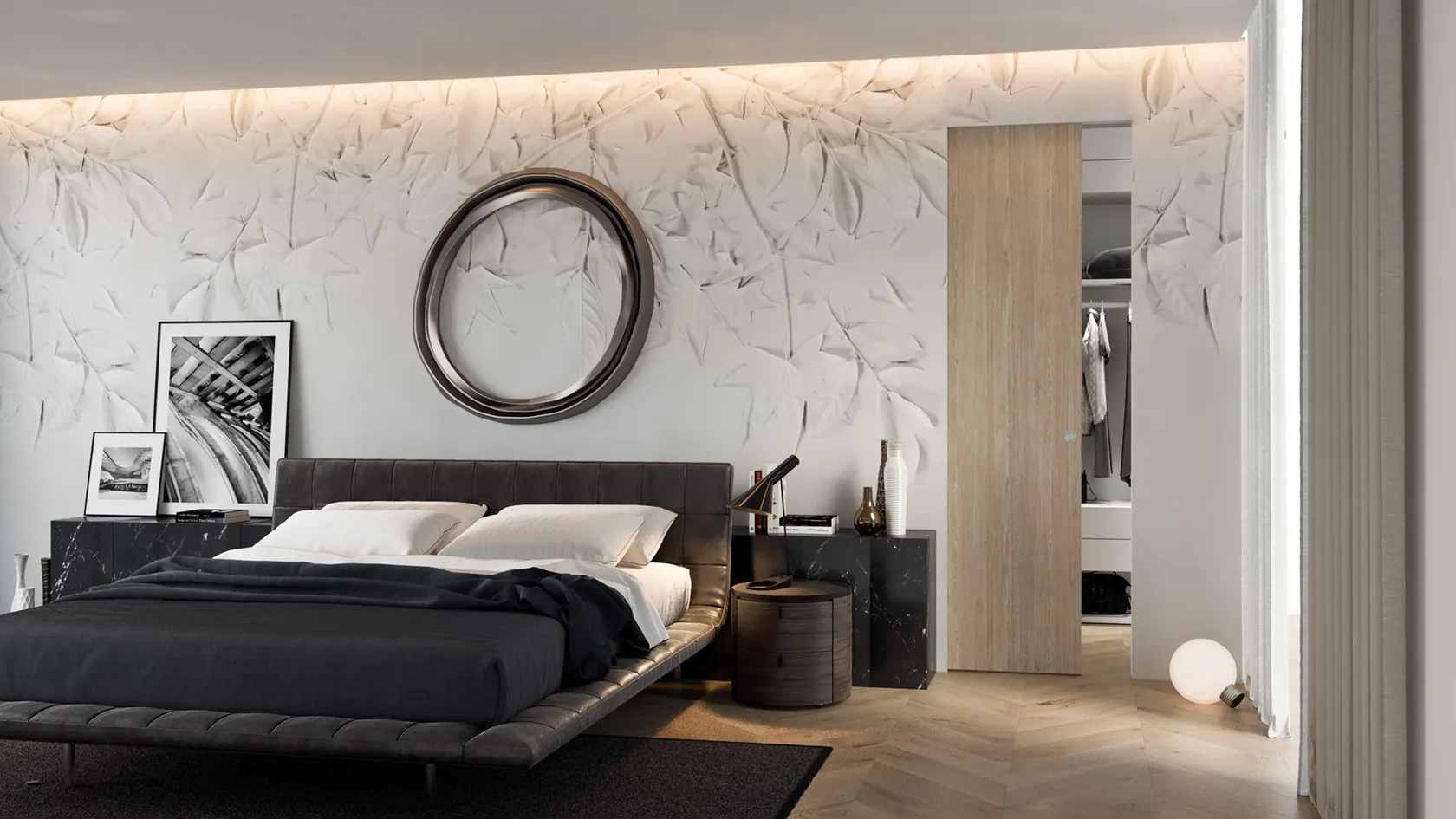
They are the latest trend in interior design and are almost a must-have in high-society homes and prestigious offices. They perfectly embody the dominant principle of our times: formal minimalism, a style that conveys elegance, sophistication, and meticulous attention to detail.
These are flush-to-wall doors, also known as wall-flush doors. Industry professionals, however, define them with the technical term “flush-to-wall systems” because the key element is not the door itself, but the subframe that houses it and allows it to disappear inside when opened.
There is a total absence of jambs, frames, and architraves, so the flush-to-wall door appears to come directly out of the wall, in the case of a pocket door solution. However, it is also possible to install hinged doors that, once closed, blend perfectly into the wall.
But what are the pros and cons of an invisible flush-to-wall door? Let’s take a look together.
Main advantages of flush-to-wall doors
Space saving. Like all pocket doors, flush-to-wall doors make it possible to save quite a lot of space, making them an almost indispensable choice for small apartments or homes with many rooms. In a medium-sized apartment, the space saving has been estimated at around 8%.
Maximum integration with the wall. Flush-to-wall doors do not interrupt the continuity of the wall, creating a beautiful visual effect. This is why they are preferred by almost all interior architects. For this same reason, they are often sold unfinished, in a raw state, so that the end user can paint them the same color as the wall they are installed in, or even cover them with the same wallpaper. Of course, it is also possible to follow the opposite approach, choosing contrasting colors that make the space more dynamic and creative.
Flexibly connecting adjacent spaces. A major advantage of flush-to-wall pocket doors is the possibility of connecting adjacent rooms, creating spatial continuity when needed or making it possible to quickly create more private and acoustically separated areas. From a lighting point of view as well, especially if the wall allows the installation of a double subframe, a flush-to-wall pocket door can bring a great deal of light even into the interior rooms of a property.
Hiding service areas. From a functional standpoint, a home includes many spaces that are better kept out of sight in public use. In this case, flush-to-wall hinged doors represent an extremely practical and cost-effective solution. The doors become one with the wall, and even the handles can be replaced with push systems, making them almost invisible. Panels are also available for cabinets and smaller compartments, even non-square ones, as in the Absolute Smart model.
Suitable for any type of wall. The installation of a subframe for a flush-to-wall door can be carried out both on masonry walls and plasterboard walls. Even the passage of electrical wiring inside the wall is not a problem, by choosing specially designed models such as Absolute Energy.
Prices of flush-to-wall doors
By their very nature, pocket doors are an architectural element with high added value in terms of design. For this reason, the choice of materials and finishes is extremely personal and also of great importance from an economic point of view.
A flush-to-wall system consisting of a subframe and door can vary greatly in price depending on the model chosen (basic or with electrical wiring, single or double), the type of door installed, standard or custom sizes, and the included accessories (soft-close system, simultaneous opening, motorized opening, etc.).
Generally speaking, prices can start from €450.00 for a model with a minimal level of customization, standard door and dimensions, and no accessories, and can exceed €2,000.00 for a top-of-the-range double-door system with tempered glass door and the accessories most requested by customers.
Disadvantages of flush-to-wall doors
Are there really any disadvantages to purchasing this type of door? Let’s look at what, more than actual disadvantages, could be considered obstacles along the way. It is better to be prepared if an invisible flush-to-wall door is our dream!
Installation: installing flush-to-wall doors can be more complex than installing traditional doors and may require professional intervention. This can increase the initial project costs.
Maintenance: although flush-to-wall doors are designed to last over time, they may require periodic maintenance to ensure that the sliding mechanisms and concealed hinges function properly.
Costs: flush-to-wall doors tend to be more expensive than traditional doors, not only in terms of installation but also in terms of purchase price. However, the cost may be justified by the aesthetic and functional advantages they offer.
Structural limitations: in some cases, the installation of flush-to-wall doors may be limited by the structural characteristics of the building. For example, it may not be possible to install a subframe in load-bearing or very thin walls.
Sound insulation: although flush-to-wall doors can offer good sound insulation, they may not be as effective as traditional hinged doors in certain situations. This can be an important factor to consider in environments that require a high level of acoustic insulation. Each situation should be evaluated individually.
Conclusion
In our experience, we can assure customers that those who choose to install flush-to-wall doors in their home, whether in the basic or top version, never regret the decision. On the contrary, over time the aesthetic and functional pleasure of enjoying this type of solution only increases.
People become so accustomed to this type of door that they no longer want to see traditional hinged doors in future properties they purchase, as these are now perceived as a drawback.