News & Trend 01/29/2026
Sliding doors: all the pros and cons
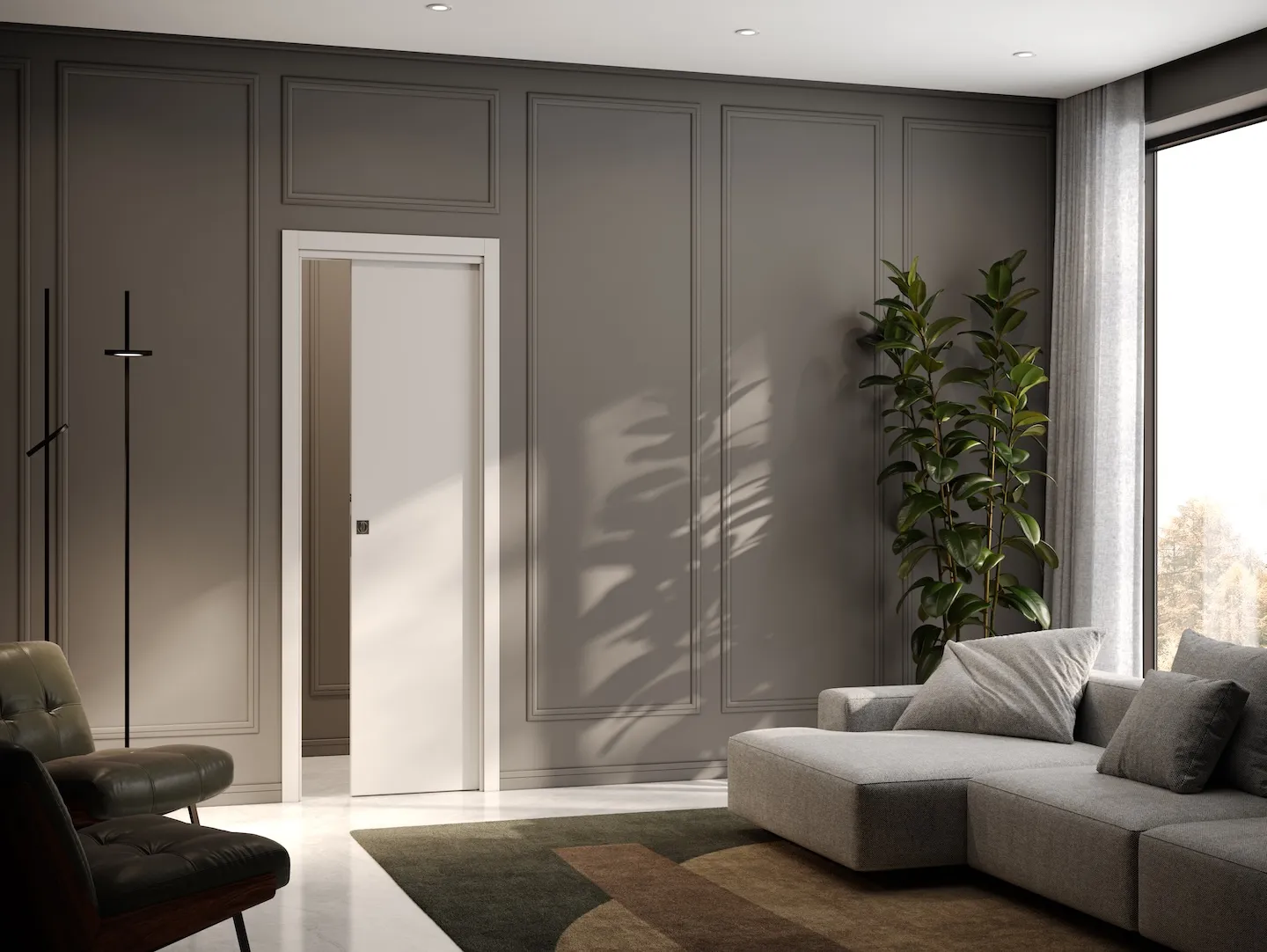
In this article, we will examine the pros and cons of sliding doors. These innovative and modern designs can transform the interior of your home whilst making the most of the available space.
Interior doors are often seen as a secondary feature. However, to best complement a property’s design, choosing the right door can add aesthetic value to the overall look.
In the following sections, we will discuss three advantages of a sliding door, three disadvantages, and the alternatives available on the market to this solution.
If you’re ready, we invite you to follow us and step inside this fascinating article, which will provide you, in brief, with some interesting insights into sliding doors that you may not have considered before!
Advantages of sliding doors
A modern, high-quality sliding door allows you to make the most of the space in your home and seamlessly connect two adjoining rooms, combining technology and design to bring your personal vision to life.
Unlike other types of interior doors, sliding doors offer a number of specific advantages. Among their key strengths are:
- Optimisation of space;
- Smooth flow between rooms;
- Control over privacy and lighting.
Space optimisation
Sliding doors are specifically designed to eliminate the space required for opening, which is a characteristic of traditional hinged doors. This benefit translates into greater freedom in arranging furniture and the ability to make full use of every corner of the room.
This feature is essential in today’s world. If you stop to think about it, in modern flats every square metre gains value when furnished with balance and practicality.
The ability to place furniture, shelving or decorative items near the door without interfering with its operation maximises the potential of every room.
Flow between spaces
Due to an intrinsic feature of the design, the sliding door is perfect for creating a balanced connection between adjoining rooms and spaces. When the door is fully open—that is, when it disappears into the wall—it creates spacious and bright perspectives.
This is precisely why installing one or more sliding doors in the living area is recommended: both to control the light in the rooms and to create continuity between the living room, kitchen and dining room.
Ermetika’s classic sliding doors with door frames and architraves, such as the Evolution, embody this stylistic heritage. Our range of classic doors in white, ivory and walnut demonstrates how traditional finishes can completely transform the atmosphere of a space, from historic homes to contemporary dwellings seeking warmth and character. Classic-style sliding doors for elegant interiors demonstrate how this type of door can radically transform the perception of spaces, making them feel more spacious and welcoming. Classic sliding doors in wood or glass represent an important chapter in the evolution of these interior design elements. Glass blends harmoniously into traditional designs through etched, satin-finished or coloured decorations that evoke classic motifs.
Privacy control
Privacy control
One of the key advantages of sliding doors is undoubtedly the convenience of being able to control your privacy whenever you need to. If you require peace and quiet, simply close the door whilst maintaining the room’s overall aesthetic. But that’s not all.
By opening the door halfway, you can still enjoy privacy whilst keeping an eye on what’s happening in the adjoining room.
This scenario might arise when you want to read a book in complete peace and quiet whilst keeping an eye on your children playing in the room next door.
What are the downsides of sliding doors? Let’s take a closer look
When discussing the pros and cons of sliding doors, we often end up listening to myths or concerns linked to older-generation products.
In reality, most of what are termed ‘cons’ are simply technical aspects which, when addressed with the right knowledge and quality, prove to be negligible or even non-existent.
Let’s look at the three most common concerns:
The cost factor: expense or investment?
It is true that a high-quality sliding door may have a higher initial cost than a standard hinged door. This is due to the presence of the subframe and high-precision sliding systems.
However, it is essential to view this as an investment in enhancing the property’s value.
A sliding door allows you to reclaim floor space, increasing the room’s market value and offering a high-end design that standard doors cannot match.
Is maintenance really necessary?
There is a fear that a sliding door is ‘delicate’. In reality, modern Ermetika sliding systems are designed to last for decades without any intervention.
What is referred to as maintenance is simply a matter of good cleaning practice: just ensure the tracks are free of dust. By choosing anodised aluminium tracks and technologically advanced rollers, the smoothness of movement will remain perfect over time, without the need for constant lubrication or complicated repairs.
Wall constraints: a false problem
It is often claimed that the main drawback of a sliding door is the inability to use the wall housing the subframe (for hanging pictures or running cables).
Today, this difficulty has largely been overcome. In fact, there are specific subframes (such as the ‘Elettro’ models) designed specifically to allow the passage of electrical cables, switches and thermostats.
Furthermore, with the right technical precautions, it is possible to fix loads to the wall in complete safety.
This ‘drawback’ disappears the moment you choose the subframe suited to your home’s needs.
Alternatives to sliding doors
We have now reached the end of this brief and straightforward article, which has given you an overview of all the pros and cons of sliding doors. At this point, you might well be asking yourself: what are the alternatives to sliding doors?
At Ermetika, we offer two very interesting alternatives which, above all, can be customised to suit your stylistic preferences and your interior design project. The 2026 buying guide for classic interior doors provides detailed information on the factors that influence the final cost. The quality of the materials, the complexity of the workmanship and the sliding systems have a significant impact on the price, but represent a long-lasting investment that enhances the value of the entire property.
We are talking about flush-mounted hinged doors and external sliding doors. We invite you to discover all the details of these options directly on our website.