
Product focus 01/11/2026
Wall-mounted cable tray: with or without skirting board?
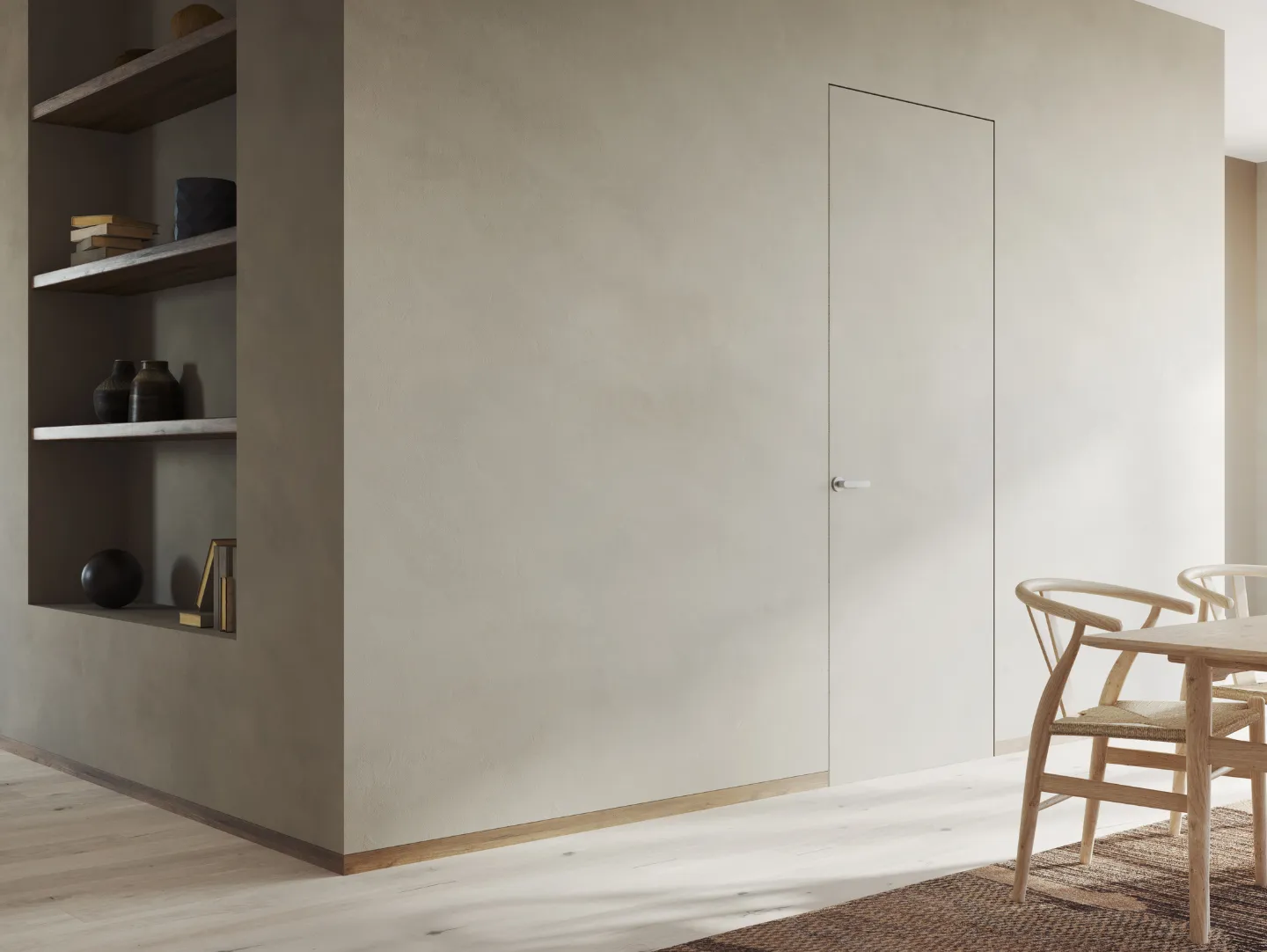
When planning an interior design or renovation project, choosing between a flush door with or without a skirting board is not a decision to be taken lightly. This element is, in fact, crucial to the success of your interior design scheme.
In this article, we’d like to briefly discuss the pros and cons of a skirting board on a flush door and how to choose the best solution to bring balance and a sense of completeness to your interior design project.
Skirting boards for flush doors: pros and cons
Flush interior doors are, today, a very popular choice for anyone looking to add a touch of modernity to their design project.
The unique feature of this product is that it literally disappears once the door leaf is closed. By becoming one with the wall, as you can easily imagine, the visual impact it creates is remarkably striking.
By choosing to install a flush door, you can opt for two types of finishes depending on your aesthetic preferences and the practicality you want from your interior design: the first finish includes the installation of a baseboard, while the second does not.
In the following paragraphs, we will look at all the advantages and disadvantages to consider if you decide to install a flush door with a baseboard.
Advantages of a baseboard on a flush door
Among the advantages of installing a baseboard with a flush door are: greater protection, a finish with a strong character, and finally versatility. Let’s analyze all three in detail.
When we talk about greater protection, we mean the usefulness of the baseboard in protecting the wall from impacts, stains, and scratches. Without this physical element, the wall would be damaged or get dirty easily and frequently.
A baseboard, especially when installed together with a flush door, can add character to the interior design you have chosen to create. It is also useful for eliminating the gap between the floor and the wall, resulting in clean and continuous lines.
Finally, in terms of versatility, a baseboard can be used as an element of coordination or contrast with both the floor and the door itself. In short, it is a product that has the potential to create harmony and continuity among interior elements, or to highlight them by playing with contrasts.
Disadvantages of a baseboard on a flush door
Among the disadvantages of a baseboard on a flush door, we can certainly mention: constant maintenance, the build-up of dust and dirt, and the bulkiness.
As already mentioned in the previous paragraphs, the baseboard serves to protect the wall from impacts, scratches, and dirt. As you can imagine, this means the item requires periodic maintenance. If it gets damaged, you will need to replace it in order to maintain a clean and elegant interior style.
Another disadvantage of the baseboard is the constant build-up of dust and dirt, especially on its top edge. This drawback, if we can call it that, can be solved by carrying out a thorough weekly cleaning. In this way, the element will always remain clean and spotless.
Last but not least, we find the disadvantage of bulkiness. If you decide to install a baseboard, you will need to consider that any furniture, shelving, or sofas will not remain perfectly flush with the wall. This could be a real issue if you are looking for clean lines and continuity between elements.
How to choose the best skirting board for a flush-fitting door
We have now reached the end of this article, which has helped you discover all the details to consider when choosing a flush door with or without a skirting board. This decision depends on your space requirements and the type of design you wish to achieve.
For this very reason, we invite you to draw inspiration from our range of flush hinged doors directly from our website.
Here, you can find out about the high-quality materials used to manufacture our doors, as well as the skirting boards and door frames recommended based on the design you wish to create; above all, you can browse our interior design projects for a more in-depth overview.
You may also be interested in: