Technical insights 04/09/2026
Internal door pocket frame dimensions: 2026 guide
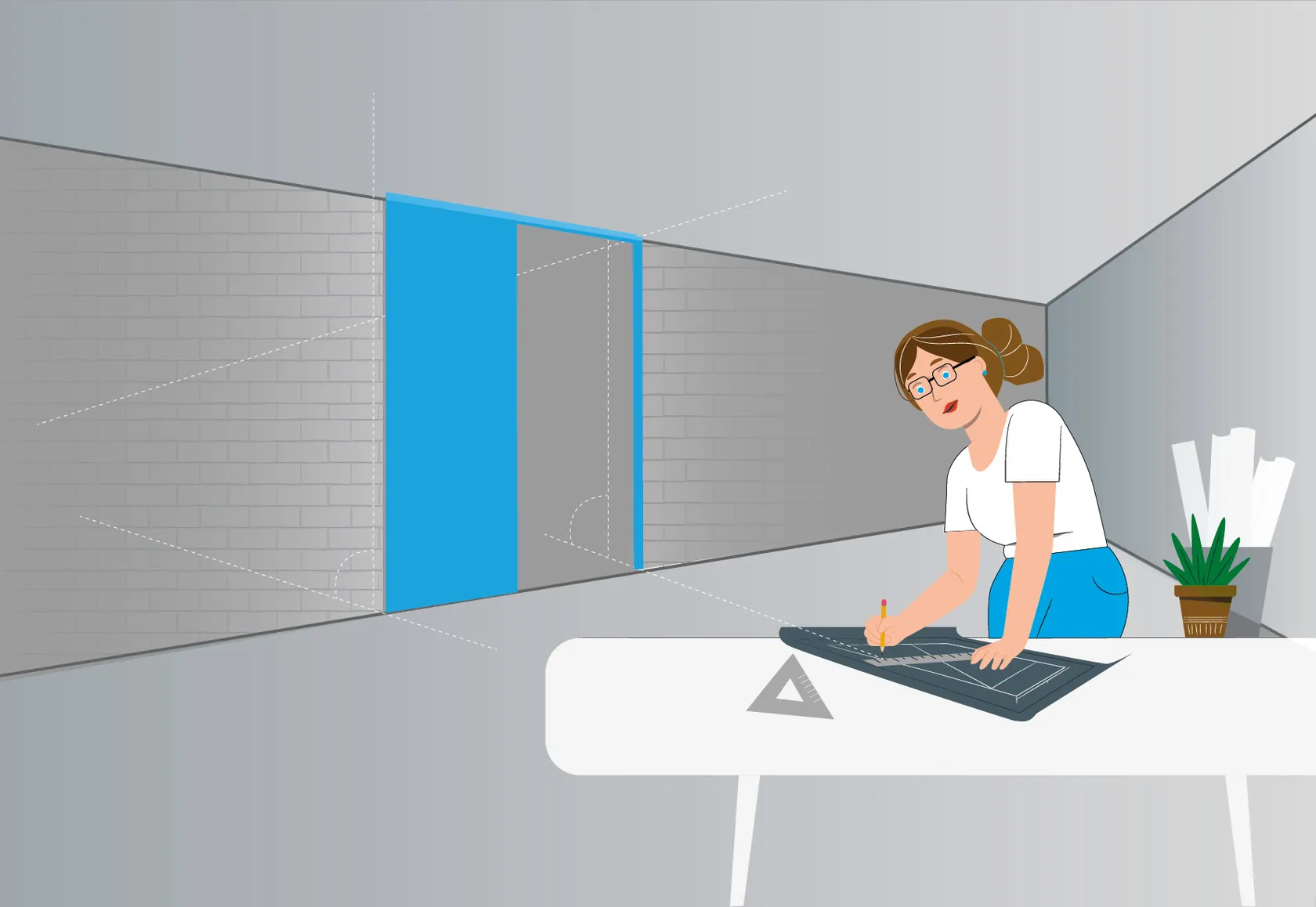
Here are the pocket frame dimensions for internal doors based on their type and size. A complete guide to help you choose the best option.
Internal doors, especially sliding ones, can add character and balance to the interior design project you want to create. In this article, we’ll focus specifically on the dimensions of the door pocket frame.
As we’ll see in the following paragraphs, some dimensions are considered standard, while others fall into the category of non-standard sizes.
At Ermetika, we give customers freedom of choice by meeting their needs, including customized door sizes, thanks to a complete and versatile product range.
Standard pocket frame dimensions for doors
Pocket frame dimensions for sliding or hinged doors are considered standard when they fall within certain parameters established by manufacturers. Among the most commonly used and appreciated are:
- 60 cm doors
- 70 cm door panels
- 80 cm doors
- 90 cm doors
These standard measurements clearly refer to the width of the door panel. As for standard height, the most common sizes on the market are 200 cm and 210 cm.
Anything that differs from these listed dimensions is considered non-standard. In fact, designing and manufacturing them takes longer than standard doors, which are almost always readily available.
Pocket frame dimensions for a 60 cm door
Pocket frame dimensions for a 60 cm door
The size for a 60 cm door and pocket frame is the minimum allowed by law. According to regulations, every space (commercial or residential) must have openings that are no less than 60 cm wide, to ensure easy passage for people.
In a residential property, for example, this size may be used for spaces such as a cellar or bathroom, which usually have smaller dimensions than other rooms.
Pocket frame dimensions for a 70 cm door
For easier passage, if the room size allows it, pocket frames can be installed to accommodate a 70 cm door panel.
This size was widely used in homes built around the 1960s and 1970s, especially for bedrooms and bathrooms.
Today, in more modern homes, a 70 cm door can also be used in a large living area. In fact, by combining two 70 cm sliding doors with the related custom pocket frame, you can create a majestic opening capable of expanding both the view and the perception of space.
Pocket frame dimensions for 80 cm and 90 cm doors
A pocket frame for 80 cm or 90 cm doors allows for very easy passage between rooms. It is an ideal size for doors separating the corridor from the living and sleeping areas, or for doors in commercial offices.
In commercial environments, there is often a need to allow the passage of machinery or bulky accessories. With these specific dimensions, it is also important to pay close attention to other parameters to ensure proper product installation.
Wall thickness is another important variable. If the wall is too thin, it may not be able to accommodate a standard pocket frame. Plasterboard walls may have different thicknesses from plastered masonry walls, which affects the choice of frame.
Read the article: Installing a Door Pocket Frame: Step-by-Step Guide
Read the article: Installing a Door Pocket Frame: Step-by-Step Guide
Non-standard pocket frame dimensions for internal doors
As already mentioned in the previous paragraphs, anything you need that does not fall within the dimensions described is considered non-standard. But don’t worry: with Ermetika, it is possible to customize the product according to your specific needs.
In modern interior design styles, such as Scandinavian design, for example, non-standard doors and pocket frames are often used, especially when the space has high, welcoming ceilings suitable for a full-height door.
To receive more accurate and precise information, simply contact us using the dedicated form you can find in the relevant section: get in touch with us. There you can describe your project and request all the information you need about the custom doors you would like to create.
Pocket frame dimensions by internal door type
To conclude this short article, which has helped you understand all the dimensions of a door pocket frame, we would like to offer an overview of the details to consider depending on the type of product you intend to purchase.
The pocket frame is not only a structural element, but also a key component that determines the functionality and aesthetics of the sliding door. It must be selected carefully, taking into account both the dimensions of the available space and aesthetic and practical requirements. The measurements to know in this case are:
- Door width and height: these measurements are crucial for determining the size of the pocket frame
- Wall thickness: as mentioned, if the wall is too thin, it may not be able to accommodate a standard pocket frame, requiring a custom solution
- Sliding door thickness: the door thickness is essential to ensure that the pocket frame can house it without problems
Taking these factors into account, let’s look in detail, and in a very simple way, at the standard dimensions to follow based on the type of door you intend to install.
Pocket frame dimensions for sliding doors
Pocket frame dimensions for sliding doors
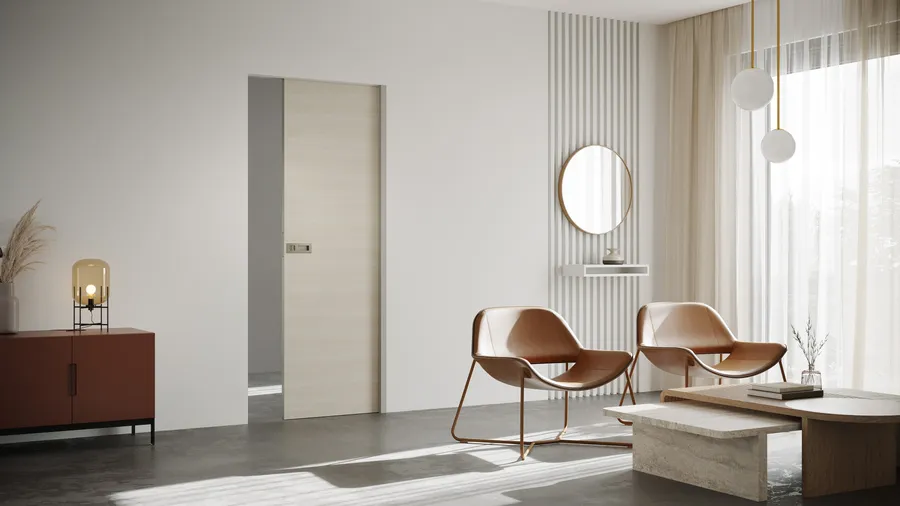
Sliding doors are an elegant and refined element capable of completely transforming the feel of a room. They are a product that, when closed, provides privacy and quiet, and when open, creates continuity between spaces.
A sliding door consists of several parts: the door panel, meaning the visible part when the element is closed; the double pocket frame built into the wall, which allows the panel to disappear when open; and the tracks, which allow smooth and silent sliding.
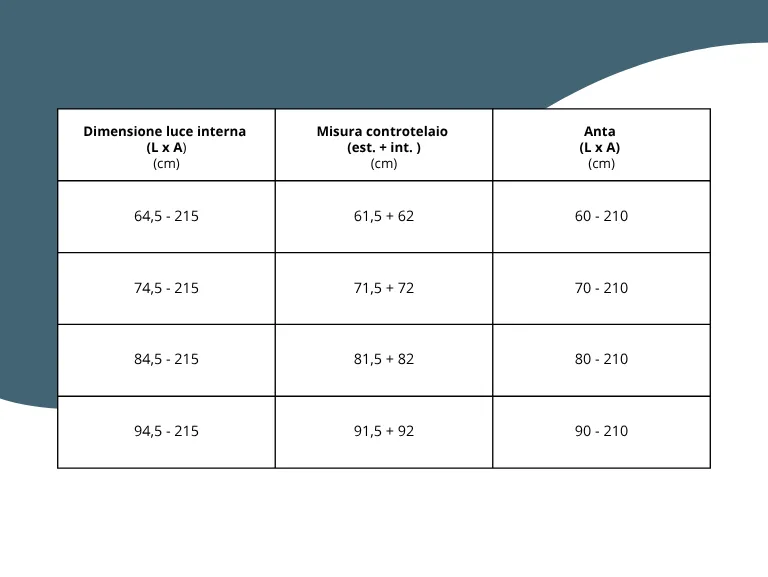
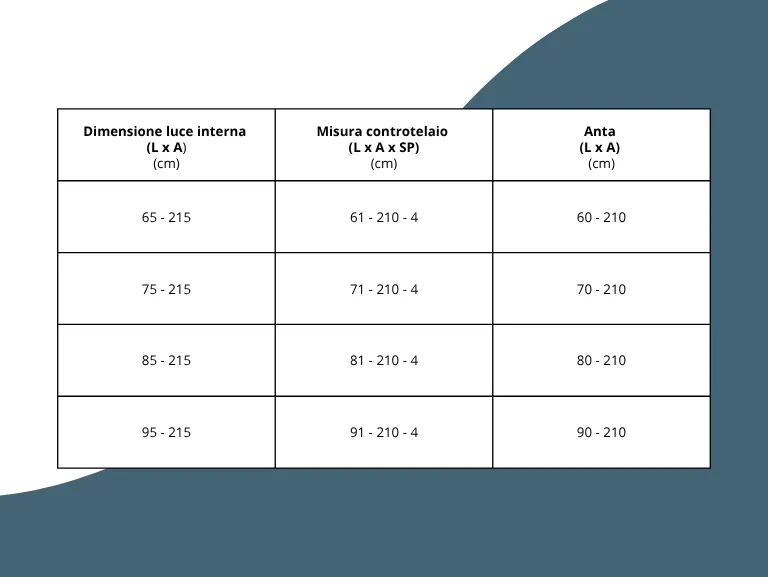
To order the correct door, you must accurately measure the internal clear opening, that is, the passage opening in which the frame and door will be installed. Based on the measurement obtained, it will be possible to choose the correct product:
Pocket frame dimensions for hinged and flush doors
For hinged doors, the situation is slightly different because the frame is much simpler than that of a sliding element. In fact, it involves applying a structure on which the door is mounted with hinges, allowing the panel to open and close.
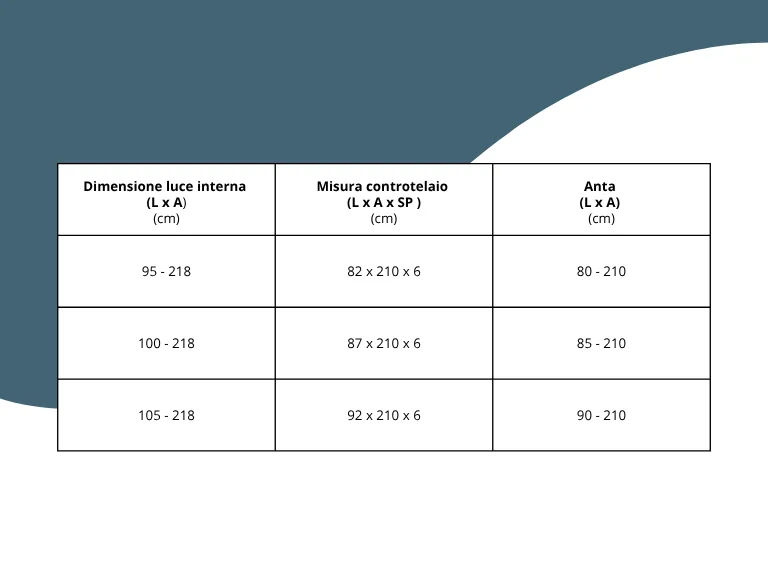
For hinged doors, you need to consider the dimensions of the internal clear opening and then choose the pocket frame (which must match the wall thickness) and the door.
Again, there is an illustrative table that should then be examined more closely depending on the specific door model you intend to purchase:
Pocket frame dimensions for security doors
For security doors, the issue of frame and door panel dimensions is different from the previous cases. A security door is usually made with thicker and more resistant materials to discourage break-ins.
In the table below, we want to present the standard dimensions of the clear opening, the frame, and the door panel, just as in the previous cases. We invite you to explore the exact details for each model directly on our website: