Technical insights 03/02/2026
Installing a Door Pocket Frame: Step-by-Step Guide
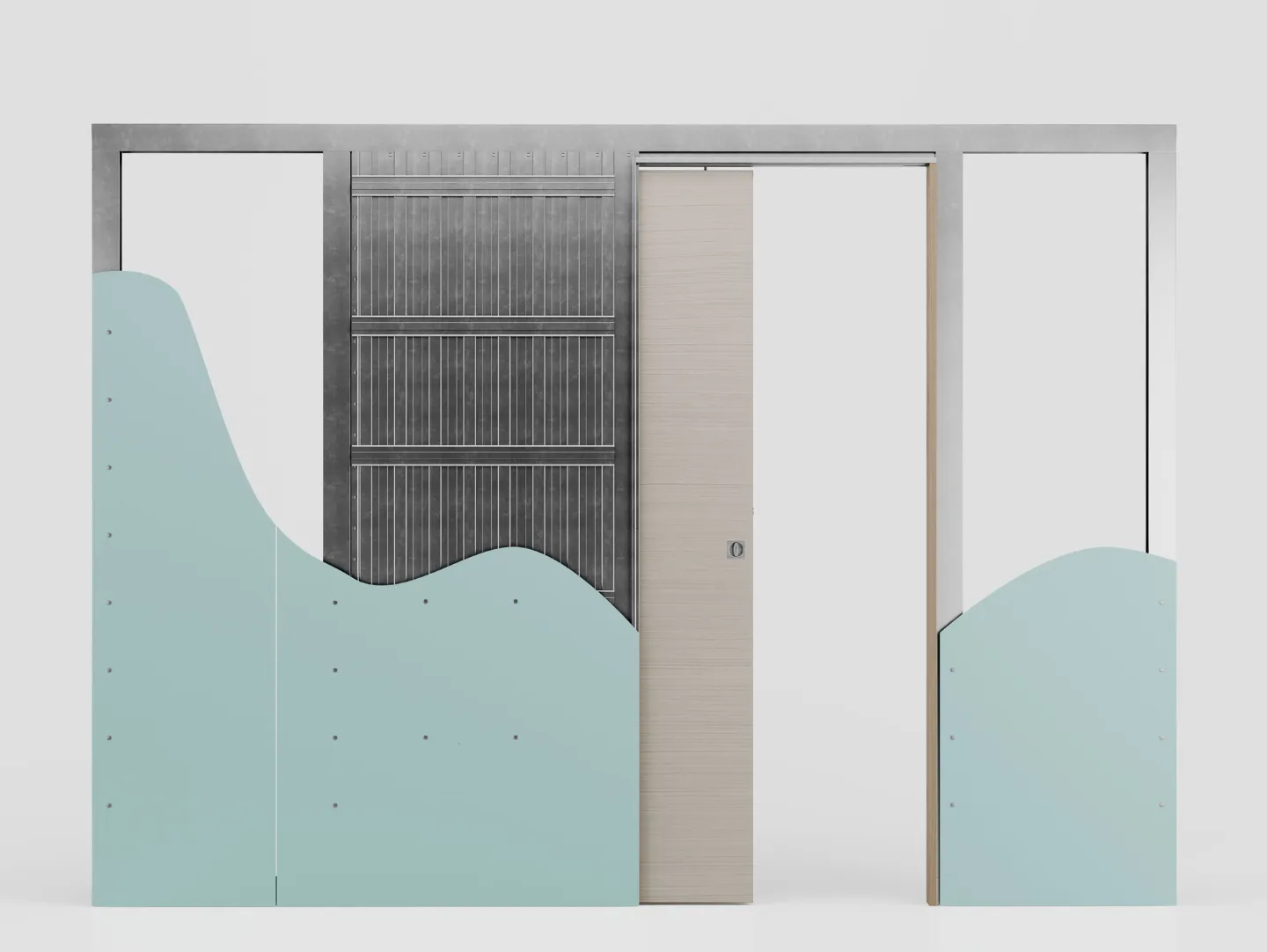
Installing a door pocket frame is not a mission impossible, and once you have read this guide, you will finally be able to fit your product on your own. For this task, however, you must be precise and have the right tools at your side.
In the following paragraphs, we will look at all the materials needed to install a door pocket frame, the steps to take before and during installation, and finally we will examine an example for fitting our EVOLUTION sliding door.
Materials needed to install a door pocket frame
In this section, we will go through all the tools and materials to use when installing the pocket frame of a sliding door. As you can easily imagine, a sliding door is made up of more than one element.
A wooden or glass door leaf; one or more sliding rails; a pocket frame that houses the leaf once it is open and that is set into the wall; jambs, skirting boards, and a handle to complete the product and make it fully functional.
To fit all these accessories, you will need:
- A drill and screwdriver – with suitable bits for drilling into plasterboard and the floor;
- A hammer – preferably with rubber reinforcements to avoid damaging the product;
- Screwdrivers – in various sizes and, ideally, both flathead and Phillips;
- A spirit level – to fit each element correctly and to make centered, straight holes;
- A pencil – to mark any drilling points on the wall and floor;
- A carpenter's tape measure – to correctly measure the size of the door's clear opening and the distances between holes.
How to install a door pocket frame
A crucial step, even before fitting the various accessories, is to check that all vertical structures (whether masonry or plasterboard guides) are perfectly plumb and level.
Once you have checked the level and the plumb, we recommend measuring the size of the clear opening. If the measurements are correct and able to contain the product you have purchased, you can then proceed with the steps listed below.
Here are the steps for installing a door pocket frame:
- Cleaning the surface and the floor;
- Assembling the pocket frame on the ground;
- Positioning and installing it on the wall;
- Fitting the sliding systems and the door.
1 – Cleaning the vertical surface and the floor
To install the pocket frame and the door, you must work on a perfectly clean surface. On a building site, as in a room under construction (or renovation), you may find dust and debris built up on surfaces.
A sliding door is a functional element, beautiful to look at, yet at the same time it needs to be assembled in a clean environment: this is to prevent any grains of sand or dirt from affecting the mechanisms or the sliding tracks.
Once you have cleaned the floor and the vertical surfaces, as in the case of the guides for plasterboard walls, you can move on to the next step.
2 – Assembling the pocket frame on the ground
Now it is time to remove the protective films from the pocket frame and the door to carry out a check of the materials. During this phase, it is essential to read the assembly instructions to confirm that all the elements have been delivered correctly and are intact.
After a quick inspection, you can proceed with assembling the pocket frame on the ground. Follow every piece of information provided on the sheet step by step, paying particular attention to letters and numbers and, above all, to the measurements of each individual piece.
At this stage, it is always useful to keep a tape measure with you to verify that everything matches the instructions. Once assembly is complete, using the correct screws and bending the indicated tabs, you can move the structure closer to the wall or the plasterboard guides.
3 – Positioning and installing it on the wall
Once the pocket frame is set into the dedicated space, but before proceeding with the fixing, check from the vertical position that every element is perfectly level and plumb with the wall.
Here, depending on the type of support you have (masonry or plasterboard), you must carefully follow the instructions that allow you to fix the pocket frame firmly to the load-bearing structure.
In the case of a masonry wall, the pocket frame will be equipped with special tabs that must fit into the recesses previously created in the wall. Once you have matched the protrusions with the recesses, you must proceed with fixing using mortar or rapid-setting cement.
If the load-bearing structure is in plasterboard, you can fix the pocket frame to the pre-installed guides directly with the appropriate screws (inside the relevant holes in the frame) that you will find included in the kit.
4 – Fitting the sliding systems and the door
Once the door's pocket frame is installed, you are almost at the end of the installation. Still following the instructions, which you will find inside the installation kit, proceed with assembling and fixing the rails that allow the door leaf to slide.
Make sure these elements are perfectly level. In this way, you will avoid unnecessary effort when opening or closing the leaf and, as a result, you will reduce wear on the door. Once all the sliding systems are fixed, you can insert the leaf before the final step: fitting the handle and the finishes.

Installing the pocket frame of a sliding door in plasterboard
To conclude this article, which has briefly allowed you to discover everything you need to know about installing the pocket frame of a sliding door, we want to offer you an example of how to fit one of our products.
We are talking about a high-quality door that, with its finishes, is capable of harmonizing modern environments and perfectly connecting two spaces together: our EVOLUTION – reliable, sturdy, and absolutely irreplaceable.
Here are all the steps, with reference figures, to install it correctly:
Assembling the product
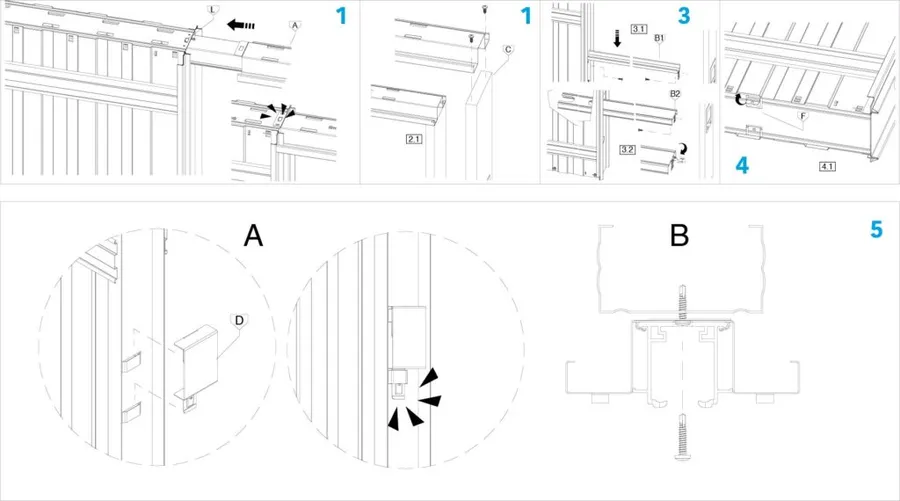
- Insert the sliding crosspiece (A) into the cassette until the tab (L) clicks into place;
- Position the closing jamb (C) and secure it with the supplied screws (No. 2 self-tapping Ø4.8×17) (See Detail 2.1);
- Proceed with fixing the upper (B1) and lower (B2) spacers, with the appropriate supplied screws (No. 4 self-tapping Ø4.8×17), needed to maintain the exact dimension of the clear passage opening (See Details 3.1 and 3.2);
- Use the lower guides for fixing to the floor;
- Apply the plasterboard supports.
Positioning the Pocket Frame
For new-build constructions, proceed as follows: Create support points at the exact level of the finished floor and lay the pocket frame.
For buildings with an existing floor, instead, carry out the following step: Position the pocket frame directly on the floor. For fixing to the ground, use points "F" (see figure 4).
Before proceeding with the installation of the door's pocket frame, pay attention to this tip: position the pocket frame plumb, taking care with the surface level. Do not install the cassette higher than the finished floor.
Installing the door leaf
Once the pocket frame has been laid, you can proceed with installing the door leaf. Ermetika systems are adaptable to wooden or glass leaves. The instructions below refer to a wooden leaf.
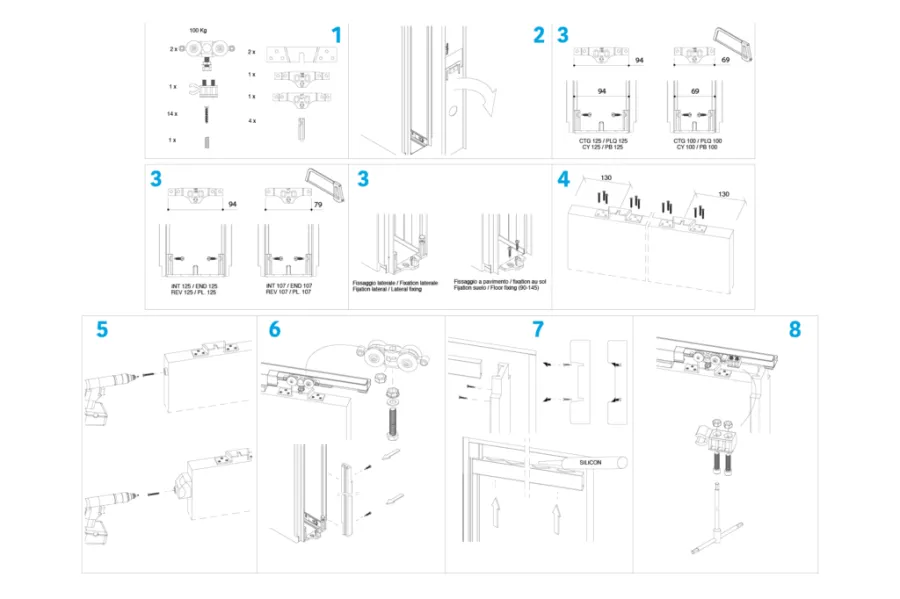
- Check that all the components of the 100 kg capacity carriage kit are present, namely: 2 four-wheel carriages, 2 brackets, 2 self-centering door guides with pins, a front door stop, screws, and bolts;
- Remove the front closing profile of the cassette and take out the box of accessories positioned inside;
- Fix the self-centering guide to the floor or to the side, depending on the thickness of the wall (as indicated in fig. 3);
- Fix the brackets to the door panel with the supplied screws;
- Fix the rear buffer to adjust the travel of the leaf;
- Assemble the carriage kit onto the track;
- Adjust, cut, and lay the vertical and stop finishing elements (jambs and cover trims), insert the seal brushes around the perimeter of the door, and position the horizontal trims;
- Position the closing limit stop, with the option to adjust it according to your needs.
To finish, you need to install the handle and its lock on the door. If you need further details to understand how to fit a plaster pocket frame for a sliding door, watch the installation video tutorial on YouTube.
You might also be interested in: