
Technical insights 11/05/2026
When is it worth choosing a custom-made door
When designing a space, the question of whether to choose a standard-size door or a custom-made one inevitably comes up. While standard sizes offer convenience and lower costs, custom-made doors deliver flawless aesthetics and make a lasting difference over time, especially in interior design projects that require millimetric precision.
In this article, we’ll explore the key criteria for choosing the ideal solution for your spaces.
Cases where it is essential
In partial renovation projects, it is quite common to encounter wall openings that do not match standard commercial sizes.
Choosing a custom-made door may be necessary in three different cases:
Choosing a custom-made door may be necessary in three different cases:
- For managing large openings: creating an impressive passage between two spaces;
- Stylistic choice: where a full-height door can enhance the room’s verticality and sense of spaciousness;
- Building renovations: in historic settings where opening dimensions are not standardized.
Choosing a custom-made door offers significant advantages such as no expensive masonry work, full use of the available space, since the door is made to the millimeter to ensure comfortable passage with no wasted space, and an essential aesthetic result, where the door seems to have been created specifically for that exact point in the wall.
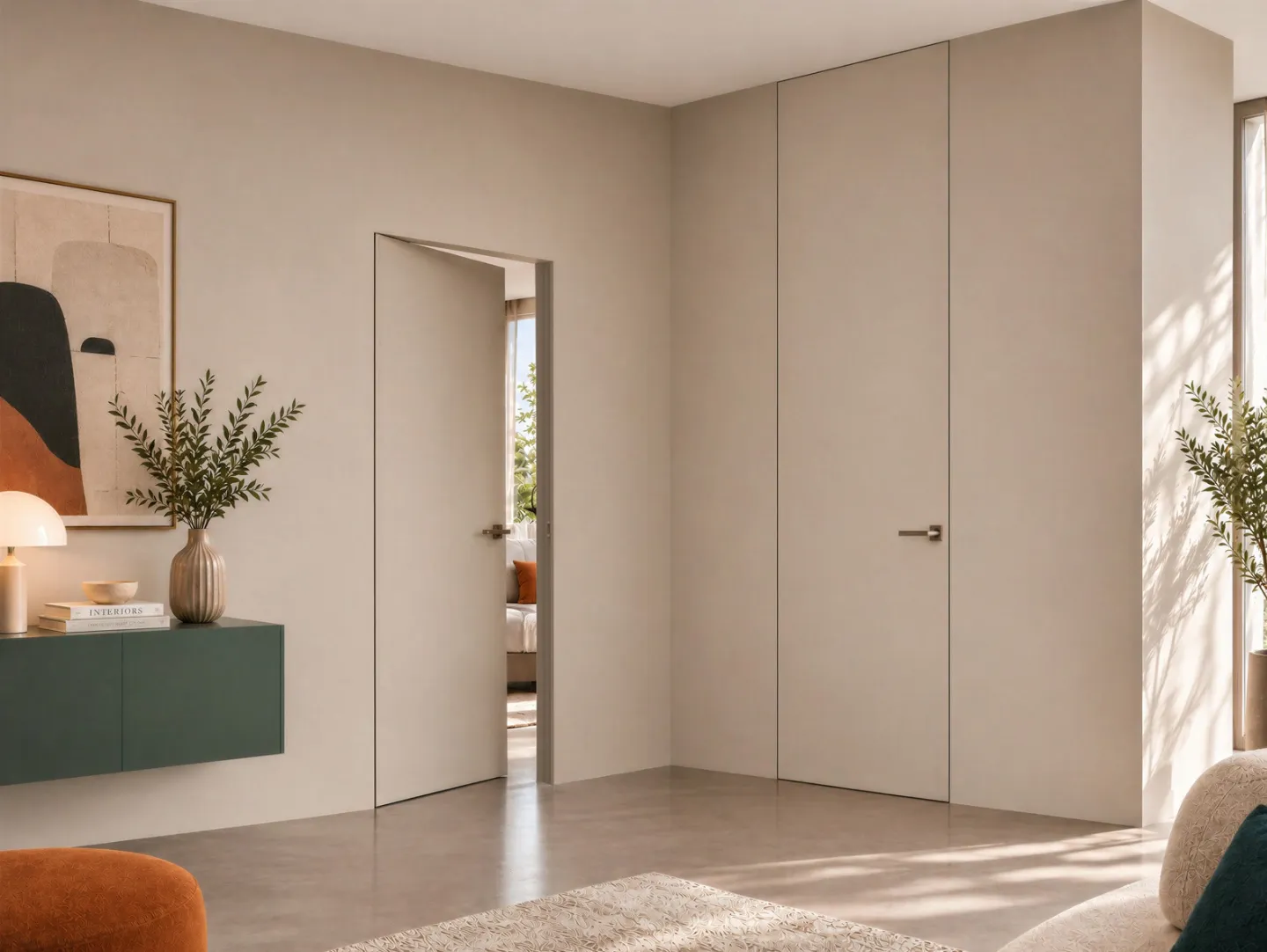
In contemporary spaces and high-end interior design projects, the door has taken on a new role: it is no longer just a functional closing element, but a true design feature. More and more architects are choosing full-height doors such as the xREVERx XL reversible flush swing door model by Ermetika, the only reversible system on the market with a height of 2400 mm. It is the ideal choice for projects that require maximum compositional freedom, as it allows the system to be installed in any direction and opening configuration, regardless of height.
When renovating a historic property, you often find yourself dealing with very thick walls, irregular slopes, or complex architectural details such as arches.
A custom-made door is an ideal solution for these contexts:
A custom-made door is an ideal solution for these contexts:
- It adapts to out-of-square walls: the custom-made door is shaped to account for the actual slopes and imperfections of the wall;
- It respects the style of the house: custom manufacturing makes it possible to preserve the proportions and historic charm of the property;
- Thermal and acoustic insulation: thanks to counterframes made to specific dimensions, the closure is perfectly airtight.
When standard is enough
When we talk about standard door sizes, we mean all those dimensions that are widely used in modern construction and meet most residential needs, usually identified with a height of 210 cm.
Standard sizes are the ideal solution in ordinary, straightforward construction contexts, especially in three specific scenarios:
- New builds: in newly constructed spaces, the counterframes are installed precisely according to the most common commercial sizes, allowing standard doors to fit perfectly without the need for on-site modifications;
- Projects with a fixed budget and fast timelines: when the main goal is to keep costs under control and complete the work as quickly as possible, an industrial product is the best ally. A door in standard sizes is often readily available in stock, significantly reducing waiting times;
- Minimalist design: in spaces where striking finishes or visual continuity solutions are not a priority.
Old and irregular masonry, often with dramatic heights, is a common feature in renovation work. In these cases, forcing the installation of a standard-size model means compromising with unattractive solutions.
How to choose the best option
When renovating or designing your spaces, it is normal to find yourself facing the dilemma of choosing the right door. The answer is never straightforward: on one hand, there are standard industrial doors, which guarantee speed and affordability; on the other, there are tailor-made solutions that resolve architectural constraints and enhance the stylistic character of the space.
To help you make the best choice before purchasing, here are three practical factors to consider:
- Delivery times: a standard door is more affordable and often ready for immediate delivery; a custom-made door, on the other hand, requires a greater financial investment and longer production times;
- Professional measurement survey: never rely on measurements taken on your own. The presence of a technician or specialized dealer is essential to assess wall thickness, out-of-square conditions, and floor slopes;
- Aesthetic impact: a door is not just a functional opening, but a true design element.
However, it is worth considering that saving on the cost of the door only to spend twice as much on masonry work to adapt the wall does not represent real savings. In addition, a full-height custom-made door, especially with a flush system, radically transforms the visual perception of the space, increasing its perceived value.